
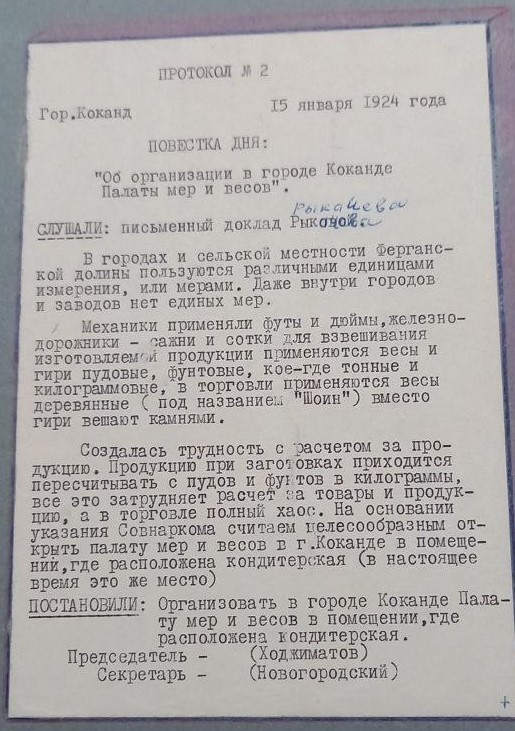
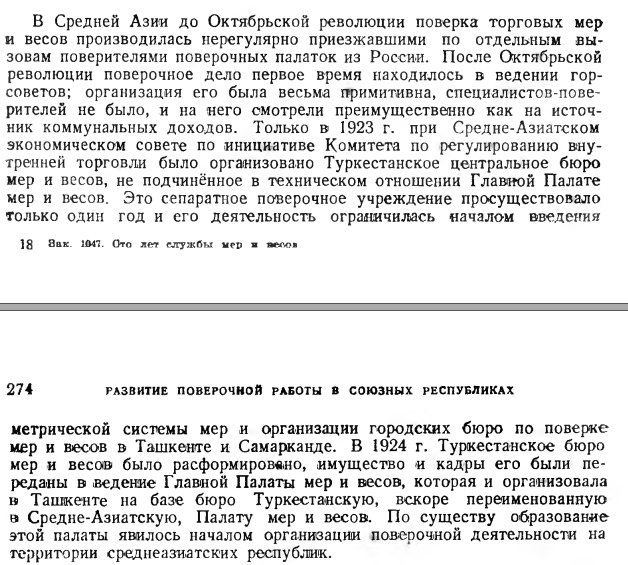
 In our country, located on the ancient Great Silk Road, the first steps in the field of metrology, i.e. measurements, were taken exactly 100 years ago. This step began to establish the uniformity of measurements by providing accurate measurements of their time. In 1924, on the basis of 2 protocols at the meeting on measurements, the Chamber of Comparison of Trade Weights and Scales was established in the city of Kokand, Fergana region, the scope of which is the entire Republic of Turkestan. At the same time, the activity of the State Control Laboratory (SCL) over the first standards and measuring instruments was established. Later, the Chamber of Comparison was changed to the Central Asian Chamber of Weights and Measures and became the founder of metrological services in the Republics of Kyrgyzstan, Tajikistan and Turkmenistan.
Until 1924, different measurements were carried out in the regions of our country with different measuring instruments. There were no single measuring instruments. For example, mechanics used feet and inches, railwaymen used sarjin and square meters of land, when measuring the weight of finished products, they used pounds and pounds, and sometwhere used tons and kilograms, and in trade, wooden scales known as “Shayin” used ordinary stones instead of weights. In the course of such disparate measurements, the recalculation of measurements in pounds and pounds to kilograms has led to confusion and complexity of accounting books in financial relations. As a result, there was a need to unify measurements in our country during this period.
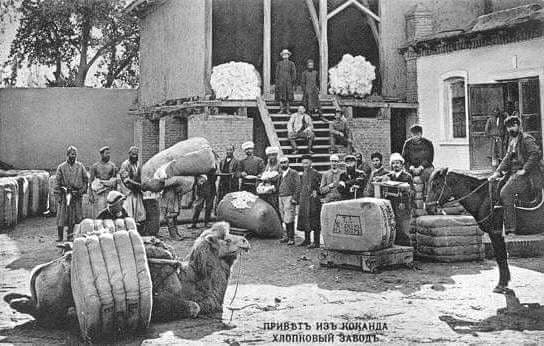 At this point, it is useful to discuss the general history of metrology. The history of measurement accuracy dates back to 300-200 BC. The first measurement of the Earth’s radius was made in Egypt by the mathematician, astronomer, geographer Eratosthenes Kirensky (276-194 BC). Without going into depth about this measurement, the great scientist Eratosthenes determined that the distance between the cities of Alexandria and Syene is approximately 5000 stadia long, and based on this, he was the first to calculate the size of the earth.
At first, the measurements were more suitable for specific parts of the human body. For example: Ladon is the width of the four fingers after the thumb, foot is the length of the sole of the foot, piad is the distance between the written thumb and index finger, a mile, an ear, a step, etc. Among them are “carat” meaning “peanut” and “gran” meaning “wheat grain”, which are widely used as a unit of measurement of various precious stones. Another manifestation of early natural measurements are the ubiquitous time measurements. In ancient Babylon, the concepts of year, month, and hour were used as units of time. Later, 1/86400 of the time taken for the earth to rotate completely around its axis was called a second. The ancient Babylonians measured time in Minas as far back as the 2nd century BC. A mine is about two astronomical hours, during which time a “mine water” with a mass of about 500 grams flowed from the Babylonian water clock. Later the mine changed to the minute we use today.
 The contributions of scientists from our country to the improvement of measurements are huge. The measuring devices, measurements and methods created by them thousands of years ago have a worthy place in the development of science and science in the Middle Ages and today, and serve as the basis for the creation of new measurement and measurement units.
The periods after the 8th-9th centuries AD are distinguished by the rapid development of science and great achievements in this regard. These achievements in scientific, cultural and educational fields served as the basis for the formation and development of a number of scientific fields in the West. The contributions of Al-Khorazmi, Ahmad Farghani, Ibn Sina and Abu Raykhan Beruni, the great scholars of “Baytul Hikma” (House of the Wise) in Baghdad deserve special attention.
Ahmad Fargoni’s writings on the making and use of the astrolabe, a measuring instrument for astronomical observations, served as the main tool for many astronomers and astrologers for several hundred centuries.
In order to ensure the international value unit of measurements, an international diplomatic conference was held in Paris on May 20, 1875, and the “Metric Convention” was signed, and the “International Bureau of Weights and Measures” was established and started its activities.
According to the decision of the President of the Republic of Uzbekistan “On obtaining the status of an associate member of the General Conference of Weights and Measures” No. PD-3663 dated April 12, 2018 the Uzbek National Institute of Metrology joined the Agreement on mutual recognition of national measurement standards and calibration and measurement certificates.
If we return to the history of metrology of our country, it would be appropriate to list the years of its development.
In 1930, the Standardization Committee was established under the Council of People’s Commissars of the former Uzbek SSR, and in 1931 it was merged with the Chamber of Weights and Scales. In the post-war years, State Control Laboratories (SCL) were established in each regional center, whose work was managed by the competent Committee on Measurement and Measuring Instruments under the Council of Ministers of the Uzbek SSR.
By 1966, the State Control Laboratories was changed to the State Control Laboratory for Standards and Measuring Techniques. The State Control Laboratory of Standard and Measuring Techniques of the Republic of Uzbekistan (UzSCL) was established in Tashkent.
Since 2017, the field of metrology of our country has started to develop with a new wave. In accordance with the decision of the President of the Republic of Uzbekistan dated April 28, 2017 “On measures to improve the activities of the Uzbek Agency for Standardization, Metrology and Certification”, the existing state institution “National Standards Center”, state enterprise “Metrology Service Center” and “Standardization, Metrology and Certification” the state enterprise “Uzbek National Institute of Metrology” was established on the basis of the metrological units of the state institution “Scientific-Research Institute”.
After that, as a result of the government’s demand and leadership, as a result of the zealous efforts, researches, and ambitions of the employees of the industry, this field has been developing and improving the legislation in accordance with the international community of metrology.
 Amendments were made to the Law of the Republic of Uzbekistan “On Metrology” adopted on December 28, 1993 on the basis of the D1 recommendation document of the International Legal Metrology Organization (OIML).
The base of national standards of the Uzbek National Institute of Metrology has been increased from 9 to 25 in the last 5 years, and laboratories equipped with the most modern high-precision measuring devices have been established in 16 regional branches.
Nowadays, activities of the institute, such prestigious international organizations as BIPM – International Bureau of Weights and Measures, OIML – International Organization of Legal Metrology, COOMET – Euro-Asian cooperation of national metrological institutions, EASC – Interstate Council for Standardization, Metrology and Certification of the Commonwealth of Independent States (CIS) establishing close relations with and carrying out equal cooperation.
Today, the export of services was launched, 6 high-precision equipment of the Azerbaijan National Institute of Metrology were calibrated, and 4 employees of the Tajikstandard Agency of the Republic of Tajikistan were trained at the institute. A positive conclusion was obtained during the assessment audit conducted by international metrological authorities.
Recent history is being sealed with the amount of work carried out in the institute in recent years.
Internet source
